We will become robots before robots become us

Who STAR TREK's Data Was, and Where He Is Now - Nerdist

Part of the overall argument of my dissertation is that the true threat of automated technology, AI, robots, etc., is not necessarily that robots are becoming dangerously human-like and that we might soon face a Matrix-style machine revolution, but rather that by increasing our interaction with automated, robotic technology we become more robotic.

I have never felt this sensation more acutely than when trying to call any kind of customer service line these days. It’s almost impossible to talk to an actual human person without first wading through a byzantine series of automated voiceover machine prompts. “Please describe your problem in a few words,” demands an affectless voice. I then proceed to ramble incoherently and in a totally unnatural cadence that results in the machine saying “I’m sorry, I don’t understand.” It’s maddening not only because you’re not solving your problem but also because you don’t feel or even sound like yourself. Seriously: next time you’re interacting with a robot voiceover, pay attention to the way you speak. It sounds more like you’re typing words into a search bar than anything resembling human dialogue; it is devoid of grammatical connector words, just a series of keywords rambled off in a frustrated tone. Never mind that the reason for the call in the first place is not easily summarized in simple sentences. Interestingly, a problem I can’t solve by Googling and that requires a phone call somehow never seems to fit into the simplistic categories that the robotic voice asks me to fit it into. Quelle surprise. But understanding poor descriptions of complex problems that defy easy categorization is something humans are very good at!

Speaking with an automated phone directory literally brings us down to the robot’s discursive level and forces us to talk and communicate like a robot does, because as humans our default social mode is to maintain interlocutor equilibrium. We subconsciously find and convert ourselves to the least common denominator in a communicative exchange. But robots can’t change their communicative register, so the only way to achieve mutual intelligibility with a robot is if we ourselves speak robotically. I find the whole experience of automated customer service incredibly frustrating and illustrative of the real threat automation poses, at least in the short term: It’s not that the robots will become like us, it’s that we will become like the robots. And of course, once we have normalized robotic human behavior, it will be much easier for differences between man and machine to cease to exist.
Who are the wise?

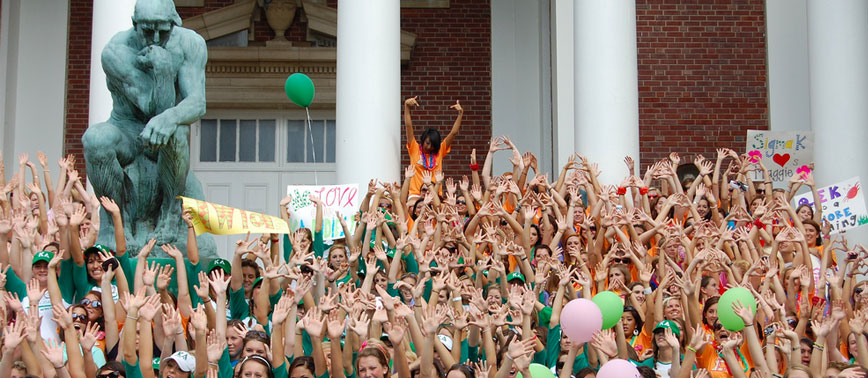
The Thinker — About UofL
The Thinker, University of Louisville

Where do we turn for wisdom in contemporary culture? Eclipsed by science, religion no longer wields the authority it once did. Our captains of industry offer nothing in the way of wisdom, as their station in life is not relatable to most people due to their unfathomable wealth. Companies offer no wisdom, only pandering and half-baked apologies for their involvement in various scandals. Celebrities are no more wise than us since they have been exposed, thanks to social media, as just as boring and sad as we are. Who holds wisdom today?

There is something: the wisdom of the crowd. In many ways, crowd wisdom has come to fill the void previously occupied by the authorial wisdom of political leaders and philosophers. In 2020, the “wisdom of the crowd” means the internet. And it’s true: the internet is full of wisdom. However methodologically flawed polling can be, I ultimately find the internet’s ability to aggregate public opinion on a topic and quantify it along a consensus scale a useful (and beautifully modern) kind of wisdom.

It’s important to distinguish wisdom from knowledge. Take user review metrics. Metrics like a movie’s Rotten Tomato score or a restaurant’s average Yelp! star count offer us data of a certain variety. We can’t say these metrics constitute knowledge, however. If the new Batman movie has a 99% rating on Rotten Tomatoes, do we know it is good? In most contexts, knowledge requires firsthand experience or observation. But if I scour dozens of product reviews on Amazon before I purchase a new keyboard, I am equipped with some kind of information about the product I didn’t have before. This information isn’t “knowledge,” but rather wisdom, or judgment, about how to navigate a world oversaturated with too many movies and restaurants and gizmos and gadgets, and the internet does it well.

Yet, this is practical wisdom. The practical wisdom offered by the internet is all good for the low-stakes struggles of discovering new movies and locating hole in the wall restaurants, but what about questions of greater significance? Where, today, might we turn for wisdom about deeper human quandaries? What about existential wisdom? Who has advice on how to live authentically during a once-in-a-century pandemic? How do we derive meaning from life when the entire US west coast is on fire? How should we live in a country whose democratic institutions are crumbling? All the gods are dead, after all, and our president is Donald Trump. Authorities have been demoted. No one is steering the ship.

To be sure, the wisdom of the crowd (read: the internet) has proven capable of addressing some of our anxieties, and could potentially solve future problems. Wikipedia, a testament to the power of collective action and an example dispositive of the omnipotence of the profit motive, functions as a kind of existential pain balm in its radical democratization of knowledge. But the Wikipedia model seems to me the exception and not the rule of the internet. In most other online ventures, the way that crowd wisdom is aggregated and repackaged in order to sell stuff or attract clicks deserves scrutiny.

The practical wisdom of the crowd is also by its nature anonymous, and therefore limited in its ability to address questions of existential significance. The existential wisdom I and I’m sure many others crave right now requires a personal, if individual, character. Crowd wisdom, on the other hand, is depersonalized, extracted by averaging together the opinions of many, meaning that its very process minimizes the impact of individual outlier data points; crowd wisdom is a resistant statistic.

That’s all good, and perhaps even preferential, for yielding an average movie score, but diluting existential wisdom by averaging it neutralizes one person’s wisdom with another’s thoughtlessness. And the challenges facing America today are anything but average; America is quite literally an outlier statistic in many of the most important metrics: gun deaths, covid-19 cases, per-capita health insurance spending, etc. It seems to me that a country determined to persist as an outlier may require outlier wisdom as a counterbalance. At any rate, sound judgment, prudence, and virtue—the ingredients of wisdom—are not traits easily expressed in aggregate.

A lot of things feel like they’re nearing their end these days: the US west coast, in-person education, democracy, the American dream. We know this. But knowledge simply won’t suffice, and neither will aggregate and practical crowd wisdom. Existential wisdom is what we need in such times. We already know how bad things are; the question is what will we do about them?

Education Discernments for 2017

tultican's avatartultican

The education journalist Kristina Rizga spent four years embedded at Mission High School in San Francisco and apprehended this key insight concerning modern education reform: “The more time I spent in classrooms, the more I began to realize that most remedies that politicians and education reform experts were promoting as solutions for fixing schools were wrong.” (Mission High page ix)

California Adopts Reckless Corporate Education Standards

Standards based education is bad education theory. Bad standards are a disaster. I wrote a 2015 post about the NGSS science standards concluding:

 “Like the CCSS the NGSS is an untested new theory of education being foisted on communities throughout America by un-American means. These were not great ideas that attained ‘an agreement through conviction.’ There is nothing about this heavy handed corporate intrusion into the life of American communities that promises greater good. It is harmful, disruptive and expensive.”

View original post 1,858 more words